|
|
![]() |
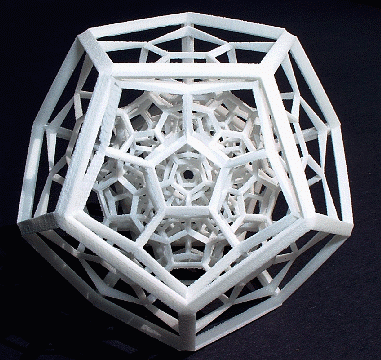
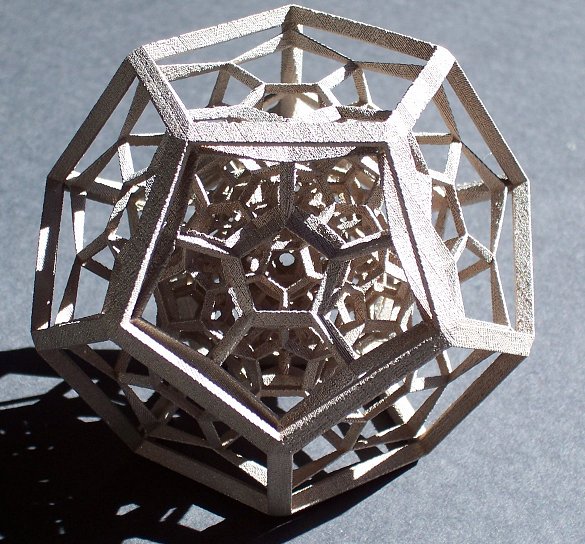
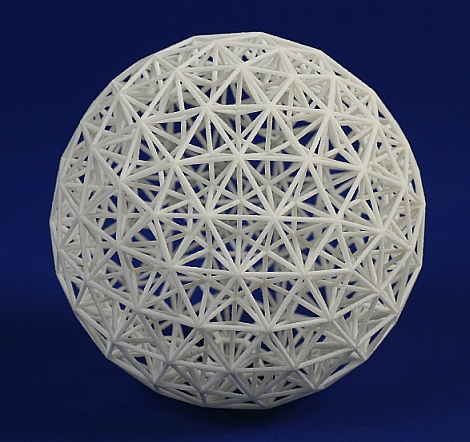
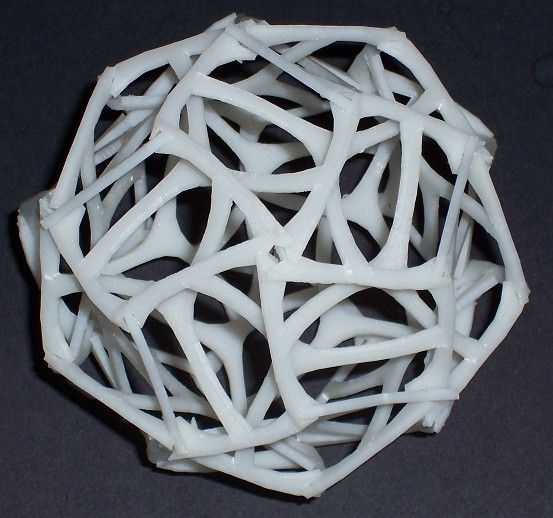
| The 120 Cell is a 4D structure made of
120
regular dodecahedra. This "shadow" of it has the form of one large
dodecahedron
filled in with 119 smaller dodecahedra. In 4D all the dodecahedra are
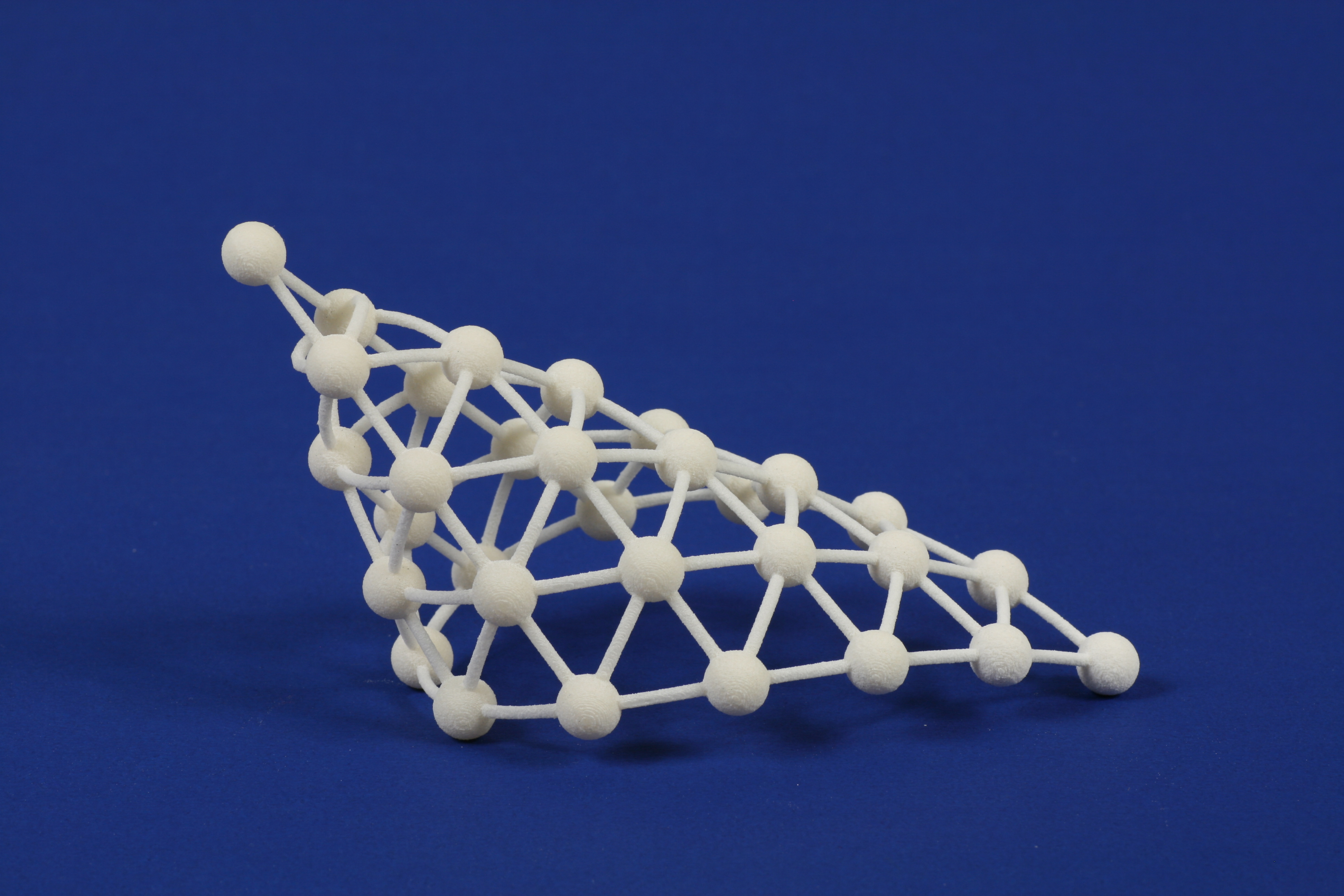
regular,
but in this 3D shadow, angles are necessarily distorted, so only the
innermost
and outermost dodecahedra appear regular. At right is shown an SLS model, about 3 inches in diameter, made on a DTM 2500Plus machine. It is a beautiful object to hold in your hand and rotate slowly. To make your own, just download this STL file (0.35MB) and send it to your local RP machine. Below is a gorgeous 4-inch model made by the Extrude Hone "ProMetal" process. Made of stainless steel powder which is infiltrated with bronze to braze it together, it should be quite long lasting. So I am happy to think that in 2000 years, someone could be holding this same model in their hands and spinning it around as I am now. These are available for purchase through Bathsheba Grossman. |
|

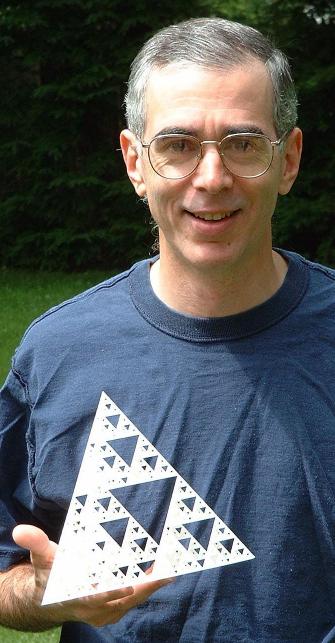
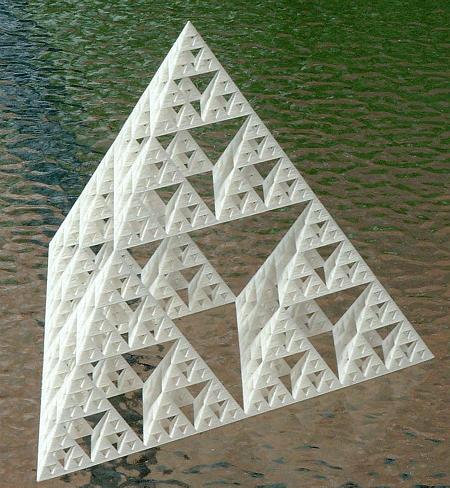
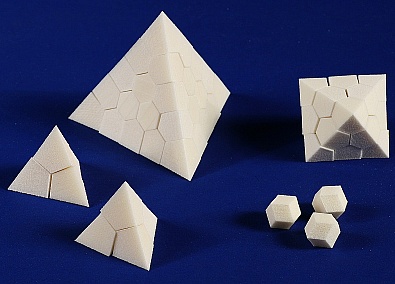
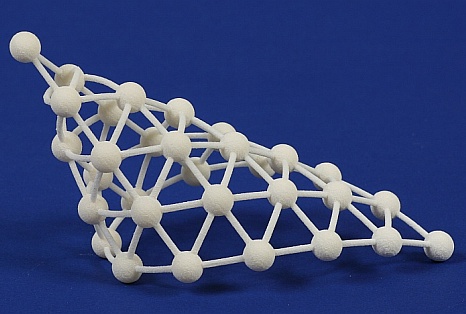
| Here is a popular fractal, often called the Sierpinski
Tetrahedron, because it is a three-dimensional generalization of
the two-dimensional Sierpinski triangle. This is a "fifth-order"
version, as there are five different sizes of octahedral holes. This
model is scaled so the tetrahedron edge is about 8.5 inches long. You
can get a better sense of scale from the image at the top of this page. It is easy to write a program which generates a computer-rendered image of this form, but it usually has the little solid tetrahedral parts just barely meeting at mathematical points. If you designed a physical model like that, it would fall apart into dust. An RP machine requires a well connected solid interior (with a triangulated manifold boundary) so the software to produce this file has a few tricky aspects. Here is the stl file (1.0 MB) for you to download and feed to your own RP machine, to make your own model. |
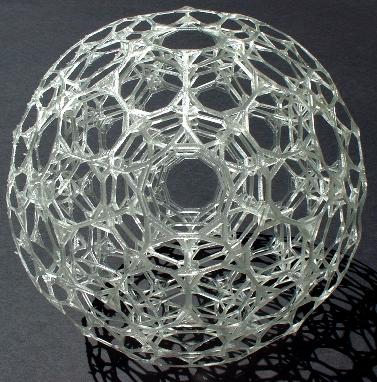
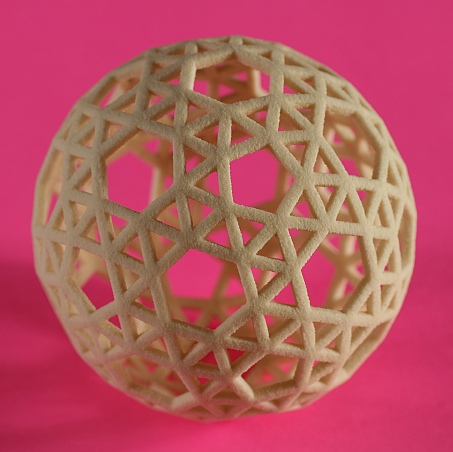
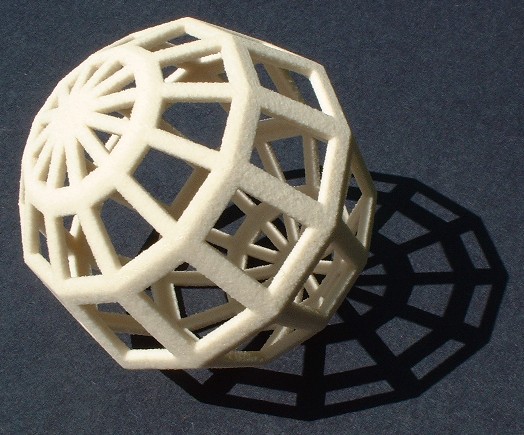
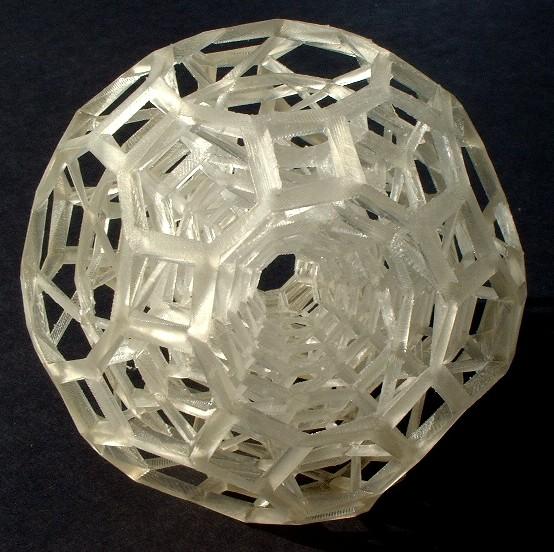
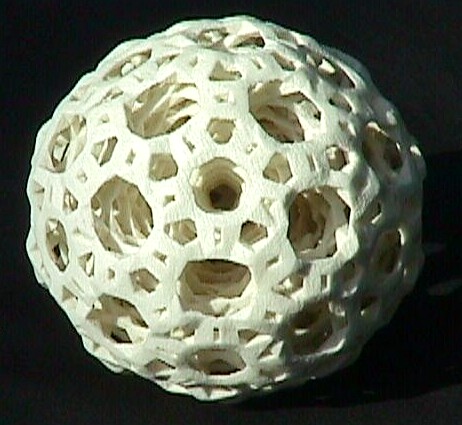
| Even more beautiful and intricate is the truncated
120-cell,
a 4D object made of 120 truncated dodecahedra and 600 tetrahedra. At
right
is shown an SLA model of an orthogonal shadow of it, about six inches
in
diameter. It is quite stunning to view the tunnels which penetrate it
in
six different directions. To make your own, just download this STL file (0.81 MB) to send to
your local RP machine. The paper cited above also describes this structure. I used these and many other 4D shadow models in a seminar on The Fourth Dimension which I taught at Stony Brook University in the spring of 2003. You may also be interested in reading a paper describing the mathematics behind this and other models of 4D objects I have made. |
|
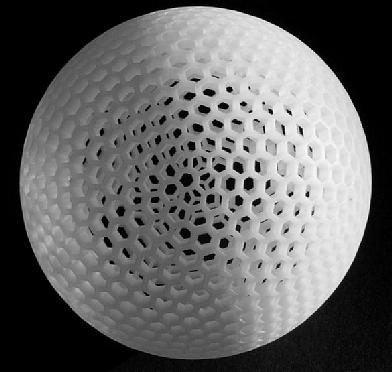
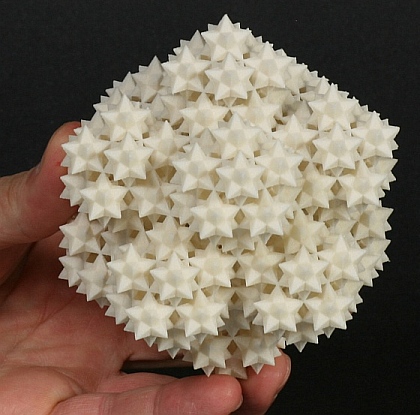
| This is a model of a polyhedron
first described by the mathematician Michael Goldberg in a 1937 paper.
(It
is "8,3" in his series of such polyhedra. For this model, I chose
the
largest one with under 1000 faces; it has 972 faces---12 pentagons and
960
hexagons.) But as far as I know, neither he nor anyone else in the
intervening
years had previously worked out how to calculate the lengths and angles
to
make these polyhedra with planar faces. I'll describe more about these
polyhedra
and ways to make them in a future paper. This is a five-inch diameter model made on a 3D Systems InVision machine. If you want to make your own, here is the STL file (1.7MB). |
|
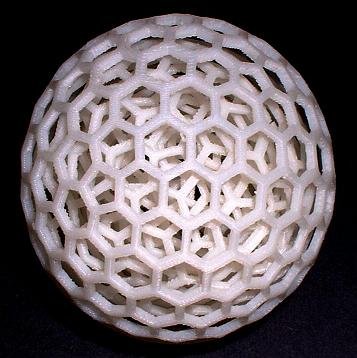
| Here is a nested series of seven spheres which
can rotate freely, independently of each other. This construction is an
homage to the long tradition of turning concentric ivory spheres on a
lathe. As outlined on this
page, this artistic tradition started in Nuremburg in the
seventeenth century and is still carried out in parts of Asia. Each sphere is based on the edges of a different Goldberg polyhedron. From inside to inside, they are:
When built, the twelve pentagons are aligned in all the spheres, so you can look right through them in to the center and out the other side. After randomizing the orientations, it is something of a puzzle to restore this property. |
|
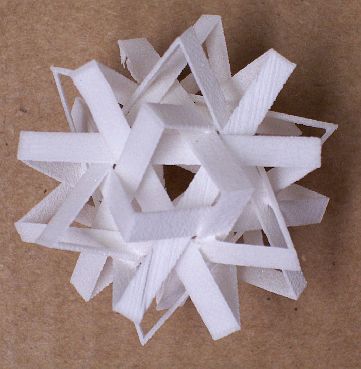
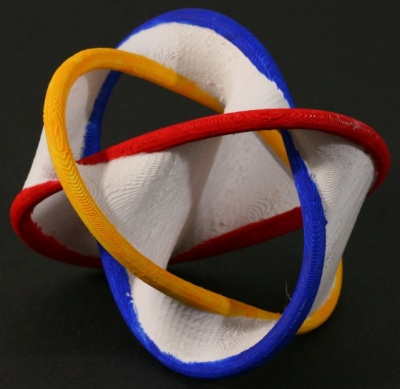
| This is a tangle of ten
equilateral triangles, just one of many interesting polygon tangles
first described by Alan Holden. The stl file is here (0.01 MB). For the history of these forms and many more examples, see this paper. The bottom of that page also has a link for you to get the java software which I wrote that allows you to generate the stl files for all of Holden's tangles plus infinitely many new ones. |
![]() |
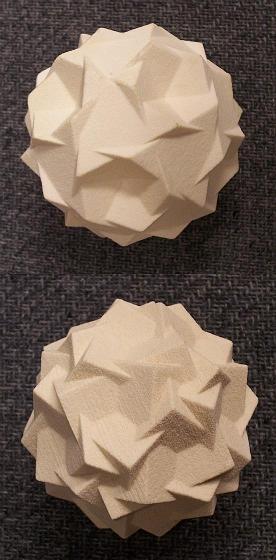
| Here are models of two uniform
polyhedral compounds with icosahedral symmetry. These were first
described in the mathematics literature by John Skilling in 1976. I
don't know
of anyone making a physical model of either of them before I made these
in 1999. At top is the compound of five concentric truncated tetrahedra. Below is the compound of six concentric pentagonal prisms. To understand these, you must see each as several interpenetrating solids. In the compound of five truncated tetrahedra illustrated at top, you can see a large equilateral triangle facing you. Its edge length is roughly the same as the overall radius of the object. There are also large hexagons of the same edge length. One truncated tetrahedron consists of four of these triangles and four of the hexagons. The overall form is five of these interlocked. Similarly, in the lower figure find large squares and pentagons of the same edge length. Five squares and two pentagons make one pentagonal prism, and there are six interlocked prisms. It may be easier to see the structure if you read the stl file into a 3D viewing program and slowly rotate the view. The models are made of plaster on a Zcorp machine, which uses inkjet printer technology to squirt water selectively in the places where the plaster dust is to be hardened, leaving the unmoistened plaster dust to be vacuumed away. The stl files are here (0.03 MB) and here (0.03) MB. |
![]() |
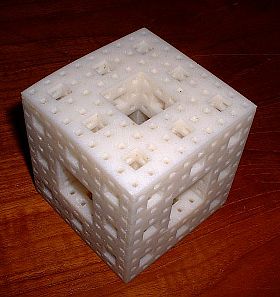
| Here is another popular fractal,
the Menger sponge. The FDM model shown at right is third-order, i.e.,
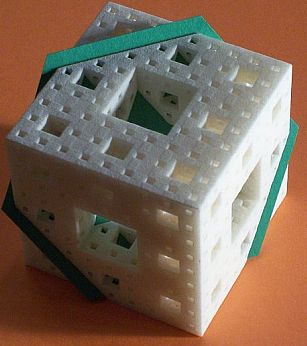
there are three sizes of holes. The stl file to make your own is here (1.8 MB). The surface area (and therefore file size) grows exponentially with the order. If you would like me to email you the 26 MB stl file for a fourth-order Menger sponge, let me know. It is easier for you to generate it on your own computer. A simple algorithm can be based on the idea that a voxel is empty if there exists a trit position (in base three representation) where two or more of its X, Y, and Z coordinates have the value one. If you have access to Mathematica, you can use my software in this paper to generate stl files for Menger sponges of any order. The lower image at right shows two halves of a third-order Menger sponge, with a hexagon of paper between them. You probably know how to cut a cube in half with a planar slice to create a hexagonal cross section: you cut on a plane which is a perpendicular bisector of any of the cube's four long diagonals. (If you don't understand this, go cut a cube of cheese or potato, then come back.) A great visualization exercise is to figure out what the cross section is when you cut a Menger sponge along that hexagonal slicing plane. In other words, what is shape of the area where the half-sponge is in contact with the paper? The stl file for you to build your own halves is here (1.1 MB). The model shown at right has 5.5 cm edge length, made by selective laser sintering. It is a fun puzzle to give someone the two halves together and ask them to try to visualize and draw the boundary surface before separating the halves. Then they can open it up and see how close they came to the correct cross section. To give you a chance to think about it before seeing the answer, I put a photo of the separated halves on a separate page, here. |
![]() ![]() |
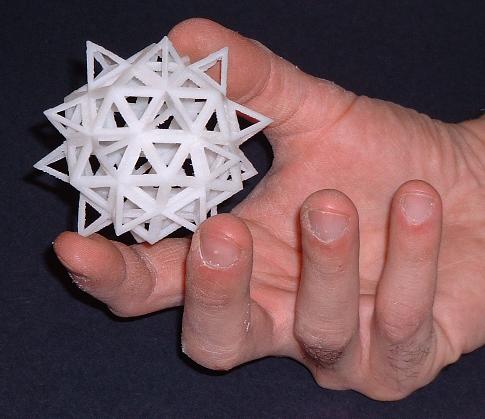
| This first is an "elevated icosidodecahedron"
composed of 120 open equilateral triangles. The model shown in my hand at right is made on an FDM machine. I have also made a wooden model of this and other Leonardo constructions, shown here. The STL file is available here (0.43 MB) for you to produce on your RP machine. |
|
| This second is a spherical form with 72 open
faces
(24 triangles and 48 trapezoids). The form was originally a
Renaissance
teaching model to illustrate one of the constructions in Euclid's Elements
(Book 12, proposition 7). The model shown is about 3 inches in diameter, made on a Zcorp machine. The STL file is available here (0.19 MB) for you to make your own. |
|
| This is six nested truncated icosidodecahedra in
an
open structure. Be sure to notice the conical corkscrew spirals
which
connect the different layers together. The model shown is about three inches in diameter, made in SLA. You can download the STL file (0.47 MB) if you want to make your own. A short paper which explains the structure is available here. |
|
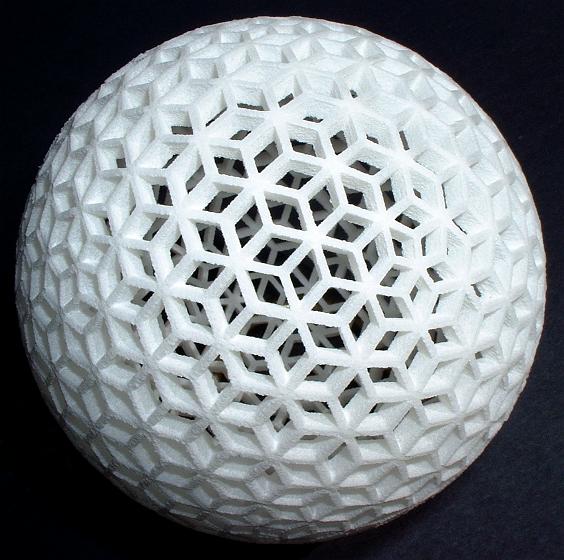
| Shown at right is an SLS model about 3 inches in
diameter
of a ball made of approximate rhombi. It is a good study model
for
understanding spatial symmetry, as it has the rotational symmetry of an
icosahedron
but no planes of mirror reflection. It is also something of an homage
to the mathematician/astronomer/instrument maker Abraham Sharp. You can download the STL file (0.99 MB) and make a copy on your own RP machine. Then search for the twelve points where five rhombi meet. (In the image one is at the very bottom, and two are on a horizontal line halfway up.) Notice that they do not point directly towards each other. The idea behind the geometry is described in this paper. |
|
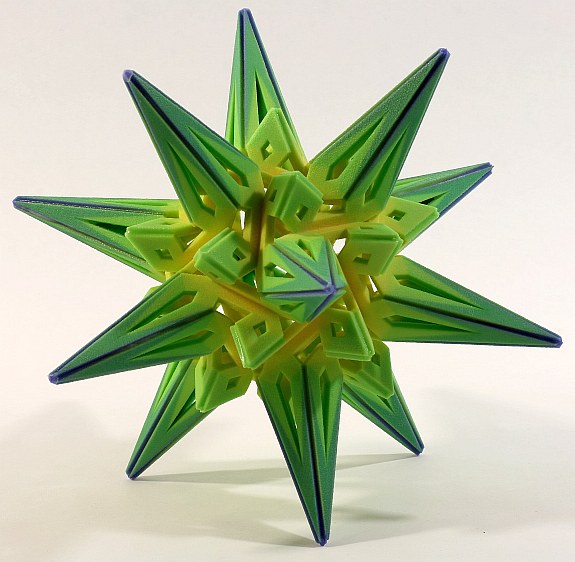
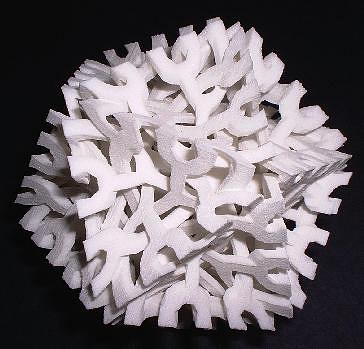
| Here is one I call Tangled Reindeer.
This
is an SLS model, about 3 inches in diameter. The idea is to
imagine
a pile of reindeer with their bodies at the center. You can have
a copy of your own by building this
stl file
(0.8 MB). Here is a paper describing the methods underlying this and some other recent RP sculptures of mine. |
|
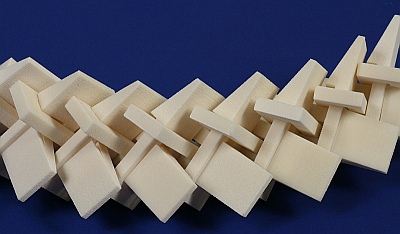
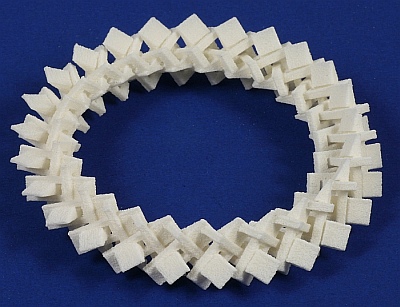
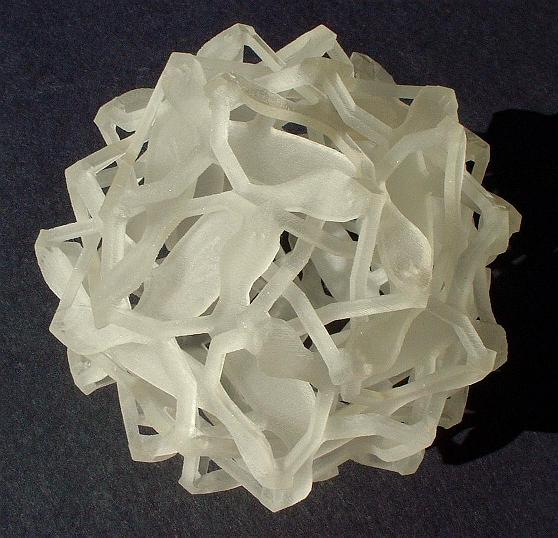
| This is a woven assemblage of Salamanders, in
homage to M.C. Escher. It is a prototype for a large sculpture assembled
in a group sculpture
barn raising I led when I was artist-in-residence
at MIT. Shown at right
is a small 2.5 inch diameter model made on a new Stratasys/Objet Eden
333 machine. This stl file (0.54 MB) is
available if you want to make your own copy. Here is a paper describing the methods underlying this and some other recent RP sculptures of mine. |
|
| This is a small SLS model of a Snarl,
which is both a puzzle and a sculpture. This 2-inch diameter scale is a
bit small for seeing all the details of the design. To fully understand
it, you can
tape together a larger paper model of it, using the template in this short paper that I presented at the
G4G6 conference in March, 2004. To make your own rapid prototype model
of the solution use this stl file (1 MB). |
![]() |
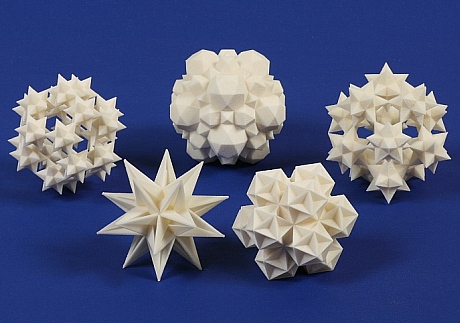
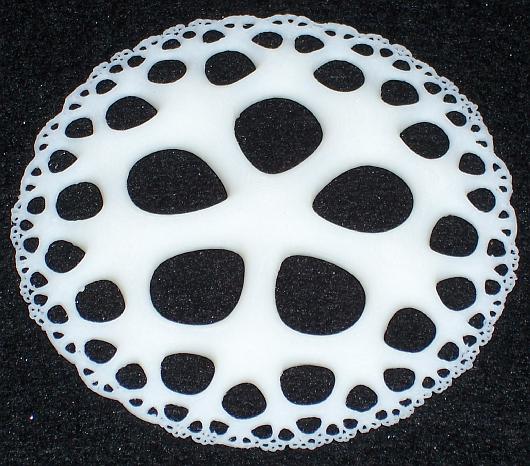
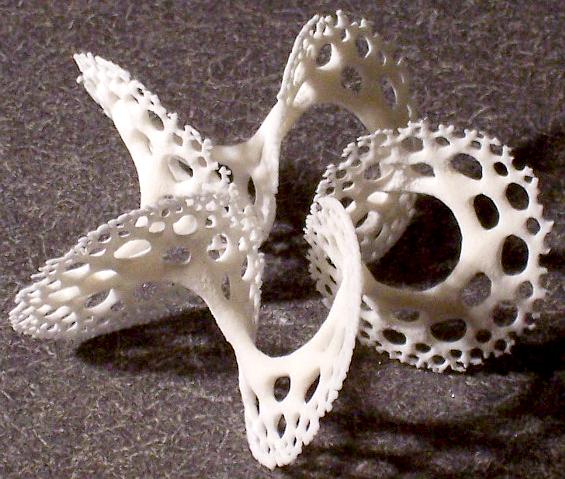
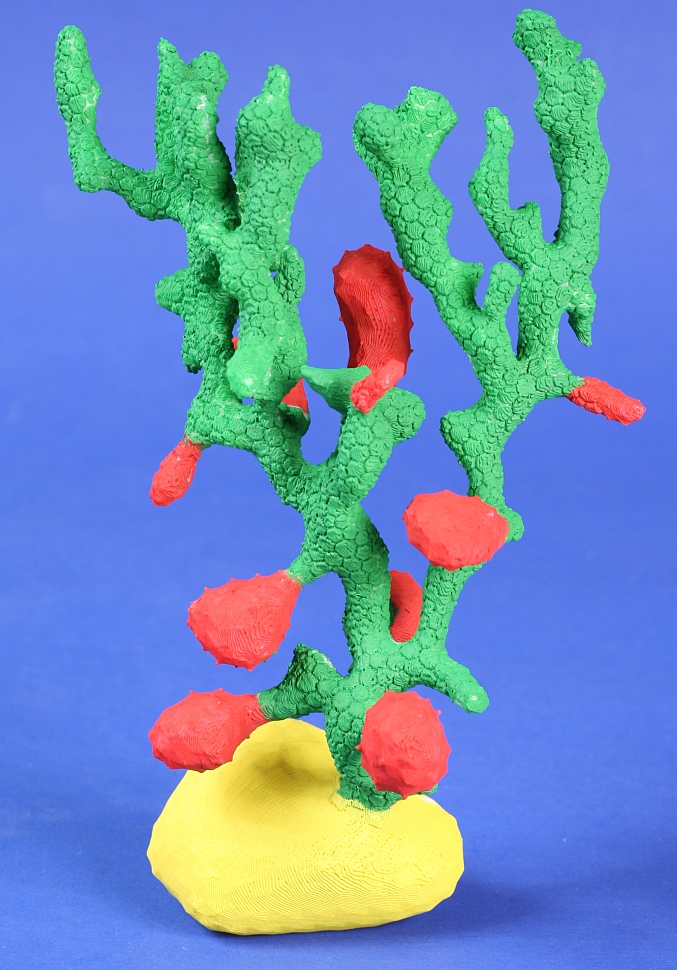
| Here is a synthesized form reminiscent of a
"sand dollar" (stl file,
1.7MB) and another which is a kind of spiral toroid creature (stl file, 6MB). Both are from a
project I call Echinodermania.
A paper describing the generating
techniques is available here.
|
![]() ![]() |
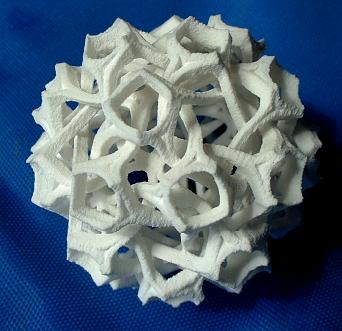
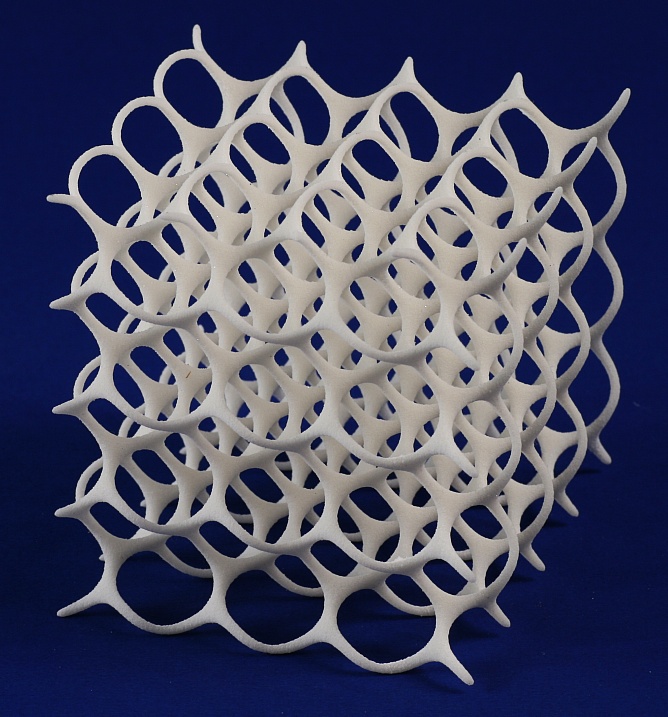
| This sculptural form is based on the (10, 3)-a
network, described in A.F. Wells' 1956 book The Third Dimension in Chemistry.
Recently the same underlying crystal structure has been popularized by
Toshikazu Sunada, who called it the K4
crystal. Its projections
in various directions are very different, so see more photos of this
fascinating 3.5 inch nylon model here. The .stl file for it is here if you want to make your own physical copy with solid freeform fabrication equipment. |
|
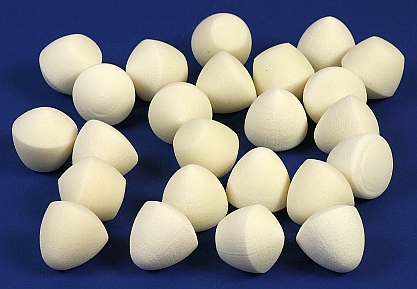
| Here is a puzzle made of twenty identical parts
that are fabricated on an FDM machine. More information is
available here. The .stl
file is available here. |
![]() |
| The algorithm described in the paper listed
below may
be of interest to people who wish to convert sets of line segments into
3D
models for RP production. The method it describes for efficiently
wrapping
segments with triangles is one of the steps in several of the
structures shown
above. At right is a 5 inch diameter form with five concentric
spheres
produced by this method. George W. Hart, "Solid-Segment Sculptures," presented at Colloquium on Math and Arts, Maubeuge, France, 20-22 Sept. 2000, and published in Mathematics and Art, Claude Brute ed., Springer-Verlag, 2002. |