- G. Hart, "Hans Hinterreiter's Flowing Fields," in Proceedings
of Bridges Richmond, 2024, Helena Verrill et al. editors, pp.
99-106. (online
copy)
- G. Hart, ‶What Can We Say about Math/Art?″, Notices
of the AMS, April, 2024, pp. 520-525.
- G. Hart, ‶Curved, yet Straight: Stick Hyperboloids″, in
Proceedings of Bridges 2023, Halifax, Judy Holdener et al. eds.
(online
copy)
- G. Hart, "The Multifaceted Abraham Sharp," in Imagine Math 8:
Dreaming Venice, Michele Emmer and Marco Abate (editors),
Springer, 2022, pp. 267-294. (draft)
- G. Hart,"Constructing Wooden Polyhedra," in Proceedings of
Bridges 2022, David Reimann et al. eds, pp. 41-48. (online copy)
- G. Hart,"The Joy of Polar Zonohedra," in Proceedings of
Bridges 2021, David Swart et al. eds,, pp. 7-14. (online copy)
- G. Hart, "Poyhedra and the Photograph," in Thinking 3D:
Books Images and Ideas from Leonardo to the Present, Daryl
Green and Laura Moretti eds., Bodleian Library, 2020.
- G. Hart, "Rubber Bandzzles: Three Mathematical Puzzle-Art
Challenges," Chapter 15 of Barrycades and Septoku: Papers in
Honor of Martin Gardner and Tom Rogers, Thane Plambeck and
Tomas Rokicki eds., AMS Press, 2020, pp. 155-160.
- G. Hart, "Comet!" Chapter 16 of Barrycades and Septoku:
Papers in Honor of Martin Gardner and Tom Rogers, Thane
Plambeck and Tomas Rokicki eds., AMS Press, 2020, pp. 163-172.
- G. Hart,"Max Brückner's Wunderkammer of Paper Polyhedra," in
Proceedings of Bridges 2019, Susan Goldstine et al. eds,, pp.
59-66. (online
copy)
- G. Hart and Elisabeth Heathfield,"Catenary Arch
Constructions," in Proceedings of Bridges 2018, Eve Torrence et
al. eds., pp. 325-332. (online
copy)
- G. Hart, review of "Mind-blowing modular origami: the art of
polyhedral paper folding, by Byriah Loper" Journal of
Mathematics and the Arts, 11:3, pp. 180-186, 2017. (online
reference) (online
copy)
- G. Hart and Elisabeth Heathfield, "Making Math Visible," in
Proceedings of Bridges 2017, David Swart et al. eds., pp. 63-70.
(online
copy)
- G. Hart and Elisabeth Heathfield, "Rhombic Triacontahedron
Puzzle," in Proceedings of Bridges 2016, Eve Torrence et al.
eds., pp. 609-614. (online
copy)
- G. Hart, "Kissing Puzzle," Cubism
for Fun, issue 99, pp. 18-21.
- G. Hart, "Tunnel Cube," Math Horizons, Feb. 2016, pp.
22-23
- G. Hart, "Laser-Cut Plywood and Cable-Tie Sculptures," in
Proceedings of Bridges 2015, Kelly Delp et al. eds., pp. 77-84.
(online
copy)
- G. Hart, "Slide-Together Geometric Paper Constructions," in Adventures
on Paper, Math-Art Activities for Experience-Centered
Education of Mathematics, edited by Kristóf Fenyvesi,
Ilona Oláhné Téglási and Ibolya Prokajné Szilágyi, Publisher:
Eszterházy Károly College, Eger, 2014. (online
copy) (also available in Serbian)
- G. Hart, "Geometry Ascending a Staircase," in Proceedings of
Bridges 2014. (paper and
more
info)
- G. Hart, "Colossal Cardboard Constructions", Proceedings of
2013 ESMA Conference, Cagliari, Italy. (online
copy)
- Robert Hanson and George Hart, "Custom 3D-Printed Rollers for
Frieze Pattern Cookies," Proceedings of Bridges 2013. (paper and more info)
- G. Hart, "Computers and Sculpture," in Experience-Centered Approach and Visuality in the
Education of Mathematics and Physics, Barallo et al.
eds., Kaposvar Univ., Hungary, ISBN 978-963-9821-52-1, 2012, pp.
127-130. (info)
- G. Hart, "Two Playing-Card Puzzle-Sculptures," Cubism for Fun, 88, July 2012, pp. 5-8.
- G. Hart, "Three Rubber Band Puzzles," presented at
G4G10. (online
draft)
- G. Hart, "Bringing M.C. Escher's Planaria to Life,"
Proceedings of Bridges
2012, Bosch et al. eds., p. 57-64. (online copy) (online proceedings)
- I originated and wrote the Math Monday columns for Make: Online, 2009-2012
- G. Hart, Forward to Woodcarving Magic, by
Bjarne Jespersen. (online
copy)
- G. Hart, "Symmetric Stick Puzzles," Proceedings of Bridges
2011, Sarhangi and Sequin eds., p. 357-364. (online version
and software) (online proceedings)
- G. Hart, Cindy Lawrence, Tim Nissen, Glen Whitney, "Forming a
Museum of Mathematics," in The Science Exhibition,
2010.
- G. Hart, "How to slice a bagel into two linked halves," Annals of Improbable Research,
Vol. 16, no. 1, Jan-Feb, 2010, pp. 16-17.
- G. Hart, "Goldberg Variations," Chapter 9 in Shaping
Space, (Marjorie Senechal, ed.) Springer, 2012. (Draft version contains
face templates not in final published version.)
- G. Hart, "Prototypes in the Hands of a Mathematical Sculptor,"
Journal of Visual
Communication, 2010, Vol. 9, no. 3, pp. 313-321. (journal)
- G. Hart, "Comet!" in Hyperseeing,
Proceedings
of
ISAMA 09, pp.
95-102. (online paper) (online entire
proceedings)
- G. Hart, "Growth Forms," in Proceedings of Bridges 2009.
(online draft) (online
entire proceedings)
- G. Hart, "Mutual Support" image on cover of College Mathematics Journal,
Vol 40, No. 2, March 2009, with blurb inside front cover.
(See here.)
- G. Hart, "An Algorithm for Constructing 3D Struts," Journal of Computer Science and
Technology, 24:1, 2009, pp. 56-64. (journal,
online)
- G. Hart, "Make the Egg Heads Puzzle," Make Magazine, vol. 17, Feb. 2009, pp.
143-145.
- G. Hart, "Orderly Tangles Revisited," in Mathematical Wizardry for a
Gardner, ed. Ed Pegg Jr, Alan H. Schoen, and Tom
Rodgers, A.K. Peters, 2009, pp. 187-210.
- G. Hart, "Egg Heads: A Puzzle/Sculpture" in Geometry, Games, Graphs, and
Education: The Joe Malkevitch Festschrift, ed. Sol
Garfunkel and Rishi Nath, COMAP, 2008.
- G. Hart, "FIRE", 28th
International Puzzle Party, ed. Peter Hajek et al., p.
61. (online version) (scan of printed page)
- G. Hart, "Two-Cent Wobbler," Make Magazine, Volume 15, Aug 2008, p.
136; reprinted in Make: Easy 1+2+3 Projects from the pages
of Make, Makermedia, 2015.
- G. Hart, "Screw-Together Cube," in Gathering for Gardner G4G8 Exchange Book.
(online version: .doc, .pdf)
- G. Hart, "Procedural Generation of Sculptural Forms," in
Proceedings of Bridges
2008, pp. 209-218 (online
version, Mathematica code)
- George W. Hart and Natasha Jonoska, "Knotting Mathematics and
Art: Conference in Low Dimensional Topology and Mathematical
Art," in Journal
of Mathematics and the Arts, vol. 2, no. 1, March,
2008, pp. 47-51.
- G. Hart, "Geometric Sculpture: A Survey of My Work," in
Proceedings of Second
International Science and Art Conference. (online
version)
- G. Hart, "Sculptural Forms from Hyperbolic Tessellations,"
Proceedings of IEEE
Shape
Modeling International 2008, pp. 155-161 (online pdf version)
- G. Hart, "A Twenty-Part Puzzle," Cubism for Fun, issue 74,
November, 2007.
- G. Hart, "Sculptural Presentation of the Icosahedral
Rotation Group," in special issue of CRM-AMS
Proceedings
& Lecture Notes series, for the Groups and Symmetries
Conference, AMS
publications, p. 211-214. (pdf
version)
- G. Hart, "Modular Kirigami," Proceedings of Bridges
Donostia, San Sebastian Spain, 2007, pp. 1-8. (pdf version)
- G. Hart, "Un Politopo pubblico a Venezia", in Mathematica
e Cultura 2007, Michele Emmer editor, Springer-Verlag
Italia, 2007, pp. 73-81.
- G. Hart, "Barn Raisings of Four-Dimensional Polytope
Projections," in Proceedings of International Society of Art,
Math, and Architecture 2007, Texas A&M, May, 2007 (pdf
format) (online
proceedings)
- G. Hart, "CD Sculpture Workshop" in Proceedings of
International Society of Art, Math, and Architecture 2007, Texas
A&M, May, 2007. (online proceedings)
- G. Hart, "Symmetric Sculpture", Journal
of Mathematics and the Arts, vol 1, no. 1, pp 21-28,
March, 2007.
- G. Hart, "Frabjous", in G4G7 Gathering for Gardner
Exchange Book, pp. 40-41, March, 2006. (online version)
- G. Hart, "Sculpture Puzzles" in proceedings of London Bridges:
Mathematical Connections in Art, Music, and Science,
London, 2006. (online
version)
- G. Hart, "Mathematical Connections in Art", (Renaissance Banff
conference report), Math
Horizons, February, 2006, p. 5 and inside front cover.
- G. Hart, "Creating a Mathematical Museum on your Desk", Mathematical Intelligencer,
27, No. 4, Winter, 2005. (online version)
- G. Hart, "The Geometric Aesthetic," Chapter 10 of The
Visual Mind II, Michele Emmer (ed.), MIT Press, 2005. (more
info)
- G. Hart, "Orderly Tangles Revisited", Proceedings of Bridges
2005:
Mathematical Connections in Art, Music, and Science,
Banff, AB, 2005. (online version)
- G. Hart, "Paper Polylinks", Proceedings of Bridges
2005: Mathematical Connections in Art, Music, and Science,
Banff, AB, 2005. (online
version)
- G. Hart, "Spaghetti Code: A Sculpture Barnraising",
Proceedings of Art+Math=X International Conference, University
of Colorado, Boulder, June 2005, pp. 88-92. (online version)
- G. Hart, "`Slide-Together' Geometric Paper Constructions", in
Bridges for Teachers, Teachers
for Bridges, 2004 Workshop Book, Mara Alagic and Reza
Sarhangi eds., pp. 31-42. Workshop activity presented at Bridges
2004 Conference. (online version)
- G. Hart, "A Reconstructible Geometric Sculpture", Proceedings
of ISAMA CTI 2004, DePaul University, June 17-19, 2004,
Stephen Luecking ed., pp. 141-143. (similar information available
here)
- G. Hart, "A Salamander Sculpture Barn Raising", Proceedings of
Bridges 2004: Mathematical Connections in Art, Music, and
Science, Southwestern College, Winfield, Kansas, July
2004, and in Visual Mathematics 7,
no. 1, 2005. (online
version)
- G. Hart, "Conference Report:
Bridges/ISAMA 2003", Nexus Network Journal, vol.
5 no. 2 (Autumn 2003). (online
journal)
- G. Hart, "Sculpture from Symmetrically Arranged Planar
Components", in Meeting Alhambra, (Proceedings of
ISAMA-Bridges 2003, Granada, Spain), Javier Barrallo et al
editors, Univ. of Granada, 2003, pp. 315-322. (online version)
- G. Hart, "Mathematics Takes Shape," Math Horizons,
April 2003, pp. 17-21. Also used online for Mathematics Awareness
Month 2003. (online copy)
(pdf
version)
- contributor to: CRC Standard Mathematical Tables and
Formulae, 31st edition, Daniel Zwillinger editor, Chapman
& Hall, 2003.
- G. Hart, "In the Palm of Leonardo's Hand," Nexus Network
Journal, vol. 4, no. 2, Spring 2002; reprinted in Symmetry:
Culture and Science, vol. 11, 2000
(appeared in 2003), pp. 17-25. (online journal)
- G. Hart, "A Color-Matching Dissection of the Rhombic
Enneacontahedron", in Symmetry: Culture and Science,
vol. 11, 2000 (printed in 2003), pp. 183-199. (online version)
- G. Hart, "Loopy," Humanistic
Mathematics, June, 2002, issue # 26, pp. 3-5.
(reprint) (online version with color image)
- G. Hart and Henri Picciotto, Zome Geometry: Hands-on
Learning with Zome Models, Key Curriculum Press,
2001.
- G. Hart "4D Polytope Projection Models by 3D Printing", to
appear in Hyperspace. (online
draft)
- "Rapid Prototyping of Geometric Models," Canadian Conference
on Computational Geometry, University of Waterloo, August, 2001.
(online
version)
- Erik D. Demaine, David Eppstein, Jeff Erickson, George
W. Hart, Joseph O'Rourke, "Vertex-Unfoldings of Simplicial
Manifolds," ACM Symposium on Computational Geometry, June 5-7,
2002. Univ. Politècnica De Catalunya, Barcelona, Spain and in
Discrete Geometry: In Honor of W. Kuperberg's 60th Birthday,
2002, Marcer Dekker Inc.
- "Computational Geometry for Sculpture," Proceedings of ACM
Symposium on Computational Geometry, Tufts University, ACM
press, June 2001, pp. 284-287. (invited speaker) (PDF version)
- Craig S. Kaplan and G. Hart, "Symmetrohedra: Polyhedra from
Symmetric Placement of Regular Polygons," Proceedings of Bridges
2001: Mathematical Connections in Art, Music, and Science, Southwestern
College, Winfield, Kansas, July 2001, pp. 21-29. (PDF
version)
- Douglas Zongker and G. Hart, "Blending Polyhedra with
Overlays," Proceedings of Bridges 2001: Mathematical
Connections in Art, Music, and Science, Southwestern
College, Winfield, Kansas, July 2001, pp. 167-174. (PDF version)
- G. Hart, "Solid-Segment Sculptures," Proceedings of Colloquium
on Math and Arts, Maubeuge, France, 20-22 Sept. 2000, and
in Mathematics and Art, Claude Brute ed.,
Springer-Verlag, 2002. (online
version)
- G. Hart, "Sculpture based on Propellorized Polyhedra,"
Proceedings of MOSAIC 2000, Seattle, WA, August, 2000,
pp. 61-70 (and Proceedings of ISAMA 2000, Albany, NY,
June 2000). (online
version)
- G. Hart, "The Millennium Bookball," Proceedings of Bridges
2000:
Mathematical
Connections
in
Art,
Music and Science, Southwestern College, Winfield,
Kansas, July 28-30, 2000, and in Visual Mathematics
2(3) 2000. (US copy)
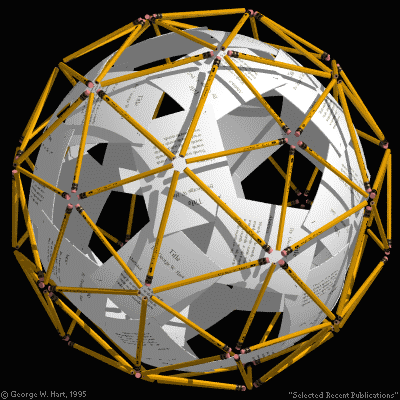
- G. Hart, Encyclopedia of Polyhedra, 200 page draft in
preparation available at http://www.georgehart.com/virtual-polyhedra/vp.html.
- G. Hart, "Reticulated Geodesic Constructions," Computers
and Graphics 24(6), Dec. 2000, pp. 907-910. (online version)
- G. Hart, "Zonohedrification," The Mathematica Journal,
vol. 7 no. 3, 1999. (online version)
(for
subscribers)
- G. Hart, "Geometric Sculpture", presentation at Carpenter
Center for the Visual Arts, Harvard University, Nov. 2, 1998.
- G. Hart, "Constructive Geometric Sculpture", presentation at
New York Academy of Sciences, Oct. 1, 1998.
- G. Hart, "Icosahedral Constructions," in Proceedings of Bridges:
Mathematical
Connections
in
Art,
Music,
and Science, Reza Sarhangi (editor), 1998, pp. 195-202
(invited presentation). (online version)
- G. Hart, Polyhedra and Art, Art and Math '98, U.C.
Berkeley, August 3-7, 1998. (online version)
- G. Hart, "Paper Prototype of a Geometric Sculpture: Whoville,"
(Invited
workshop
presentation)
Art
and
Math '98, U.C. Berkeley, August 3-7, 1998.
- G. Hart, "Zonish Polyhedra," Proceedings of Mathematics
and Design '98, Javier Barrallo ed., University of the
Basque Country, San Sebastian, Spain, June 1-4, 1998. (online version)
- G. Hart, "Calculating Canonical Polyhedra," Mathematica
in Research and Education, Vol. 6 No. 3, Summer,1997, pp.
5-10. (online
Mathematica version) (supplement)
- G. Hart "Polyhedra Models over the Internet", MAA Mathfest,
Atlanta GA, August, 1997.
- G. Hart, "A Color-Matching Dissection of the Rhombic
Enneacontahedron," Art and Math conference, S.U.N.Y. Albany,
N.Y., June, 1997. (online version)
- G. Hart, "Applications of Virtual Reality and Java for
Illustrating Polyhedral Geometry over the Internet," Conference
on Electronic Communication of Mathematics, Geometry Center, U.
Minn. June 1997.
- G. Hart, "Virtual Reality Polyhedra," Art and Mathematics
Conference, SUNY Albany, NY, June, 1996.
- G. Hart, "Nonintrusive Appliance Load Monitoring," American
Power Conference, Chicago IL, April, 1996.
- G. Hart, Multidimensional
Analysis: Algebras and Systems for Science and Engineering,
Springer Verlag, 1995.
- G. Hart, "Dimensioned Linear Algebra --- Physical Quantities
and Computational Software," Mathematica Conference for
developers and users, Champaign-Urbana, October 5-8, 1995.
- I. Rouvellou and G. Hart, ``Automatic Alarm Correlation for
Fault Identification," INFOCOM, 1995.
- V. Tsotras, B. Gopinath, and G. Hart, ``Efficient Management
of Time-Evolving Databases," IEEE Transactions on Knowledge
and Data Engineering, August, 1995, pp. 591-608.
- I. Rouvellou and G. Hart, ``Inference of a Probabilistic
Finite-State Machine from its Output," IEEE Transactions on
Systems Man and Cybernetics, March, 1995, pp. 424-437.
- V. Tsotras, B. Gopinath, and G. Hart, ``The Effect of
Universe Knowledge on Parallel Algorithms," International
Journal on Mini and Micro Computers, 1995
- G. Hart, ``Three Approaches to Nonintrusive Monitoring of
Continuously-Variable Loads,'' New Issues in End-Use
Measurements Workshop, Vancouver, British Columbia, Oct. 1994.
- G. Hart, ``The Theory of Dimensioned Matrices,'' Proceedings
of 5th SIAM Conference on Applied Linear Algebra, Snowbird,
Utah, June 1994, pp. 186-190. (online
postscript version)
- G. Hart and S. Kelekar, ``Automated Repair of Complex Systems
by Fault Compensation," IEEE/ ACM Transactions on
Networking, April, 1994, pp. 193-205.
- G. Hart, ``Automatic Construction of Finite-State Load
Behavior Models," Proceedings of Fourth International Symposium
on Distribution Automation and Demand-Side Management, Orlando,
Florida, Jan. 18-19, 1994.
- G. Hart, ``To Decode Short Cryptograms," Communications
of the ACM, Sept., 1994, pp. 102-108.
- J.F. Labourdette, G. Hart, and A. Acampora, ``Branch-Exchange
Sequences for Reconfiguration of Lightwave Networks," IEEE
Transactions on Communication, October 1994, pp.
2822-2832.
- S.G. Kelekar and G. Hart, ``Synthesis of Protocols and
Protocol Converters Using the Submodule Construction Approach,"
13th IFIP Symposium on Protocol Specification, Testing, and
Verification, Liege, Belgium, May 25-28, 1993. Also in A.
Danchine et. al. (eds.), Protocol Specification, Testing,
and Verification, IFIP Transactions C-16, North Holland,
pp. 307-322, 1993.
- I. Rouvellou and G. Hart, ``Probabilistic Finite-State
Machine Inference: An Application to Alarm Correlation," ORSA
Telecommunications Conf., Chicago, May 16-19, 1993.
- A. Bouloutas, G. Hart, and M. Schwartz, ``Fault
Identification Using a Finite-State Machine Model with
Unreliable Partially Observed Data Sequences," IEEE
Transactions on Communications, July 1993, pp. 1074-1083.
- G. Hart and A. Bouloutas,
``Correcting Dependent Errors in Sequences Generated by
Finite-state Processes," IEEE Transactions on Information
Theory, July 1993, pp. 1249-1260.
- I. Rouvellou and G. Hart, ``Algorithm for Identification of
Network Topology," IEEE Network Operations and Management
Symposium, Memphis, Tenn., April 1992.
- G. Hart, ``Nonintrusive Appliance Load Monitoring," IEEE
Proceedings, December 1992, pp. 1870-1891.
- Labourdette, J., Acampora, A., and Hart, G., ``Sequences of
Branch Exchanges for Logical Reconfiguration of Lightwave
Networks," Proceedings of Second ORSA Telecommunications Conf.,
March 9-11, 1992, Boca Raton, Florida.
- Rouvellou, I. and Hart, G., ``Topology Identification for
Traffic Configuration Management in Dynamic Networks,"
Proceedings of Second ORSA Telecommunications Conf., March 9-11,
1992, Boca Raton, Florida.
- Rouvellou, I. and Hart, G., ``Inference of a Probabilistic
FSM from its Outputs," Proceedings of Second ORSA
Telecommunications Conf., March 9-11, 1992, Boca Raton, Florida.
- J.F. Labourdette, A. Acampora, and G.W. Hart,
``Reconfiguration Algorithms for Rearrangeable Lightwave
Networks," INFOCOM, '92.
- I. Rouvellou and G. Hart, ``Topology Identification for
Traffic and Configuration Management in Dynamic Networks,"
INFOCOM, 1992.
- J.F. Labourdette and G. Hart, ``Blocking Probabilities in
Multitraffic Loss Systems: Insensitivity, Asymptotic Behavior,
and Approximations," IEEE Transactions on Communications,
August, 1992, pp. 1355-1366.
- A. Bouloutas, G. Hart, and M. Schwartz, ``Simple Finite-State
Fault Detectors for Communication Networks," IEEE
Transactions on Communications, March 1992, pp. 477-479.
- G. Hart, ``The Theory of Dimensioned Matrices," Columbia
University Center for Telecommunications Research Technical
Report, 1991.
- G. Hart, ``Advances in Nonintrusive Appliance Load
Monitoring," Proceedings of the EPRI 1991 Information and
Automation Conference, Washington, D.C.
- R. Kannurpatti and G. Hart, ``System Identification with
Unknown Model Order," IEEE Transactions on Information
Theory , September, 1991, pp. 1440-1450.
- A. Bouloutas, G. Hart, and M. Schwartz, ``Two Extensions of
the Viterbi Algorithm," IEEE Transactions on Information
Theory, March 1991, pp. 430-436.
- V. Tsotras, B. Gopinath, and G. Hart, ``Using Universe
Knowledge and Arithmetic to Get Faster Parallel Algorithms,"
Proceedings of the 2nd IEEE Symposium on Parallel and
Distributed Processing, (SPDP), December 1990, Dallas, Texas.
- V. Tsotras, B. Gopinath, and G. Hart, ``New Upper Bounds for
Parallel Merging and Maximum Finding," in Proceedings of ISMM
International Conf. on Parallel and Distributed Computers and
Systems, New York, Oct. 10-12, 1990.
- J.F. Labourdette and G. Hart, ``Link Access Blocking in Very
Large Multi-Media Networks," ACM SIGCOM '90, September 1990,
Philadelphia, PA, and in Computer Communications Review
20, no. 4, Sept. 1990, pp. 108-111.
- V. Tsotras, B. Gopinath, and G. Hart, ``A New Bound on
Parallel Searching," in Proceedings of the Fourth Parallel
Processing Symposium, April 4-6, 1990, Fullerton, CA., pp.
613-622.
- V. Tsotras, B. Gopinath, and G. Hart, ``Optimally Managing
the History of Evolving Forests," SIGAL, International Symposium
on Algorithms, Tokyo, 1990, and in Lecture Notes in Computer
Science, #450, Springer-Verlag, 1990, pp. 468-478.
- A. Bouloutas, G. Hart, and M. Schwartz, ``On the Design of
Observers for Fault Detection in Communication Networks,"
Chapter 5 of Network Management and Control, A
Kershenbaum, M. Malek, and M. Wall, editors, Plenum Press, 1990.
- A. Bouloutas, G. Hart, and M. Schwartz, ``On the Design of
Observers for Failure Detection of Discrete Event Systems,"
Network Management and Control Workshop, September 1989, New
York.
- Hart, G.W., ``Residential Energy Monitoring and Computerized
Surveillance via Utility Power Flows," IEEE Technology &
Society, June 1989.
- Hart, G.W., ``Identification of Multi-State Appliances," MIT
Laboratory for Electromagnetic and Electronic Systems Technical
Report, July 1987.
- Hart, G.W., Minimum Information Estimation of Structure,
MIT Ph.D. Dissertation, and MIT Laboratory for Information and
Decision Systems Technical Report #1664, June 1987.
- Hart, G.W., ``Nonintrusive Appliance Load Data Acquisition,"
in Proceedings: International Load Management Conference,
Electric Power Research Institute Report #EM-4643, Section 40,
June 1986.
- Hart, G.W. ``Prototype Nonintrusive Appliance Load Monitor,"
MIT Energy Laboratory Technical Report, and Electric Power
Research Institute Technical Report, September 1985, (online pdf).
- Hart, G.W., ``The Digital AC Monitor," MIT Energy Laboratory
Technical Report, August 1985.
- Hart, G.W., ``Nonintrusive Appliance Load Data Acquisition
Method," MIT Energy Laboratory Technical Report, and Electric
Power Research Institute Technical Report, September 1984.
Some Past Research Topics
My recent work is centered on computational
algorithms
and
computer
technology
in
the design of geometric sculpture,. I am also very
interested in puzzle design and
the history of geometry in
art. Some areas of my past research that people still
contact me about are briefly summarized below, with pointers to
further information.
1. Multidimensional Analysis
The study of ``dimensioned quantities," such as 1 volt, and
2 meters, and their possible interrelationships, forms an
interesting branch of applied mathematics (or physics or
engineering) called dimensional analysis. Traditionally this
field only concerns scalar quantities (not vectors and matrices).
The linear algebra which results when one considers vectors and
matrices which contain dimensioned quantities as their components
is surprisingly interesting and rich. Although it is implicit in
all branches of modern engineering, it has not been carefully
studied before.
For an introduction to dimensioned linear algebra and the
dimensional analysis of matrix relationships, be sure to check out
my Multidimensional
Analysis page, and check out my book, which
assumes an undergraduate background in linear algebra:
George W. Hart, Multidimensional Analysis: Algebras and
Systems for Science and Engineering, Springer Verlag, 1995.
Software for Scalars:

A very useful computer program (which I have written and placed
in the public domain) for manipulating, converting, and
calculating with dimensioned scalars is available, DimCalc,
runs under Windows 3.1 or higher software. The file to get is DimCalc.zip which is a compressed
package of the software and extensive on-line help information.
Expand the directory someplace and double click the dimcalc.exe file within it to
run the program.
2. Nonintrusive Appliance Load Monitoring
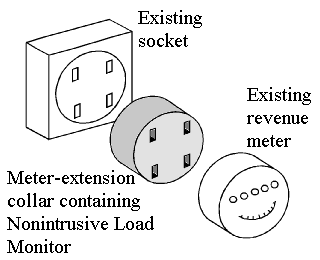
A Nonintrusive Appliance Load Monitor determines the energy
consumption of individual appliances turning on and off in an
electric load, based on detailed analysis of the current and
voltage of the total load, as measured at the interface to the
power source. The approach has been developed to simplify the
collection of residential energy consumption data by utilities,
but also has other applications. It is called nonintrusive
to contrast it with previous techniques for gathering appliance
load data, which require placing sensors on individual appliances,
and hence an intrusion onto the energy consumer's property.
An interesting aspect of this research is the interdisciplinary
manner in which it combines power systems theory and
communications theory---power consumption is decoded as an act of
information transfer. The theory and current practice of
Nonintrusive Appliance Load Monitoring, including goals,
applications, load models, appliance signatures, algorithms,
prototypes, field-test results, current research directions, and
the advantages and disadvantages of this approach relative to
intrusive monitoring are described in the following tutorial
survey article:
G. Hart, ``Nonintrusive Appliance Load Monitoring," IEEE
Proceedings, December 1992, pp. 1870-1891.
For additional on-line information, be sure to explore my Nonintrusive Appliance Load
Monitoring Page.